
Model routing & failover
This page covers how to connect model providers in NomiFun, set a default model, and orchestrate a model failover queue: when a provider temporarily fails or gets rate-limited, a Nomi engine session automatically switches to the next model you’ve ordered — no babysitting the retry.
Failover is a failover queue, not a multi-credential round-robin pool — it solves reliability, not quota aggregation. It applies only to Nomi engine sessions; ACP / CLI agents make their provider calls inside an external runtime and are out of scope here.
Entry point: the Models page in the sidebar (/models) manages every provider, model, and the global failover queue.
Steps
-
Add a model. On the Models page, click “Add model”, pick a provider type, and fill in the API key, base URL, and default model name. NomiFun ships 4 native provider backends:
- Anthropic (the Claude family)
- OpenAI-compatible — one configuration reaches any compatible endpoint: DeepSeek / Gemini / Qwen / Kimi / Ollama / vLLM / Azure OpenAI and more — just change the base URL and model name
- Amazon Bedrock
- Google Vertex
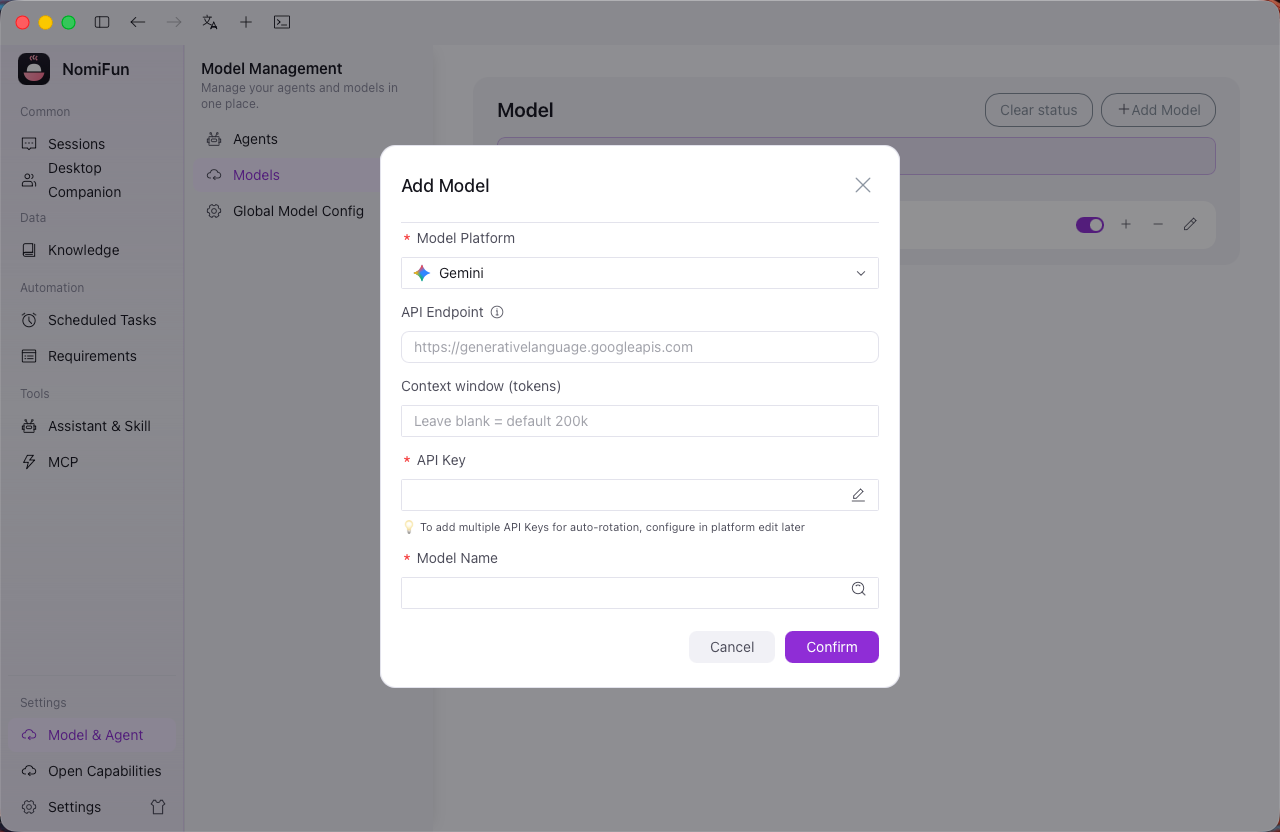
-
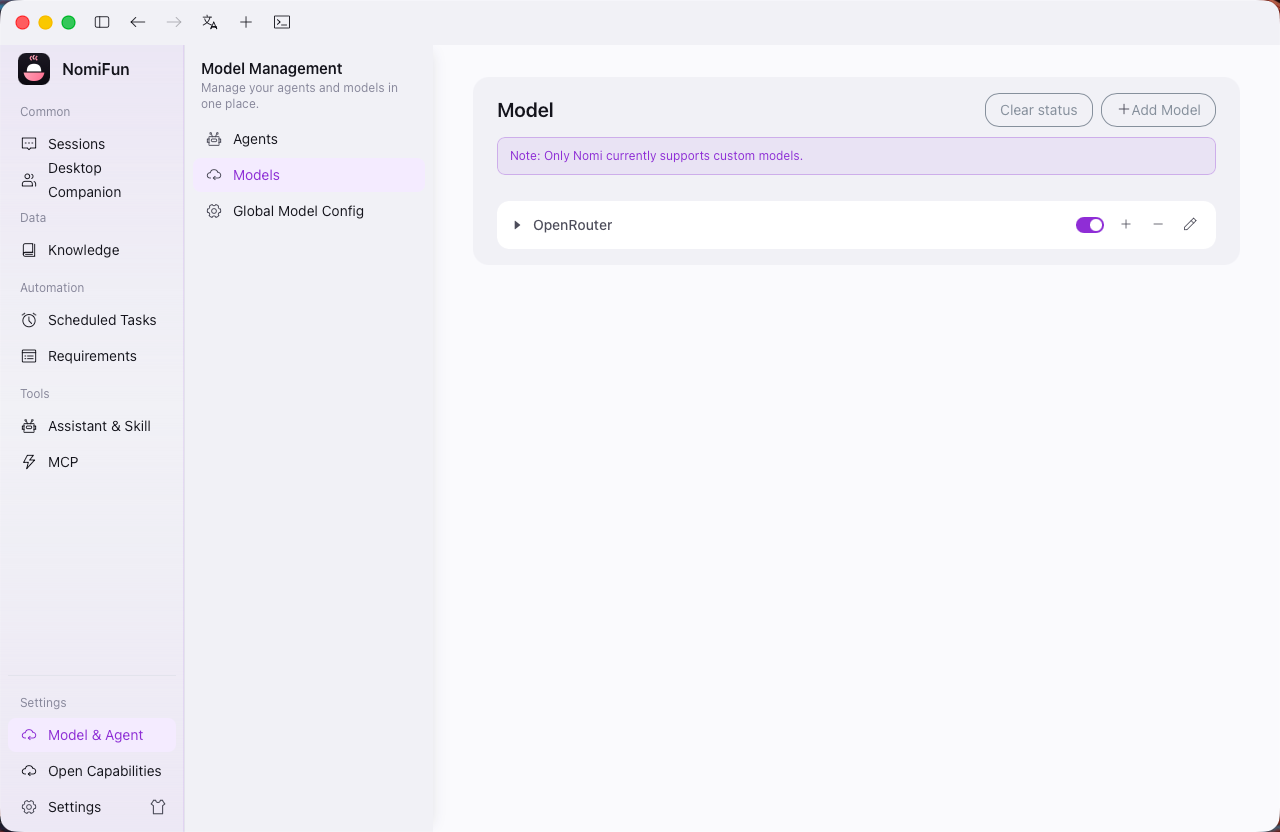
Check the model list. After saving, return to the list and confirm each provider’s status and default model. This is also where you later add, remove, rotate keys, or change defaults.
-
Orchestrate the failover queue. Open the Failover list in the global model config and order your backup models top to bottom by priority. When a session detects a recoverable provider failure (failure / rate-limit), the runtime switches to the next one in order — up to 4 switches across the whole queue.
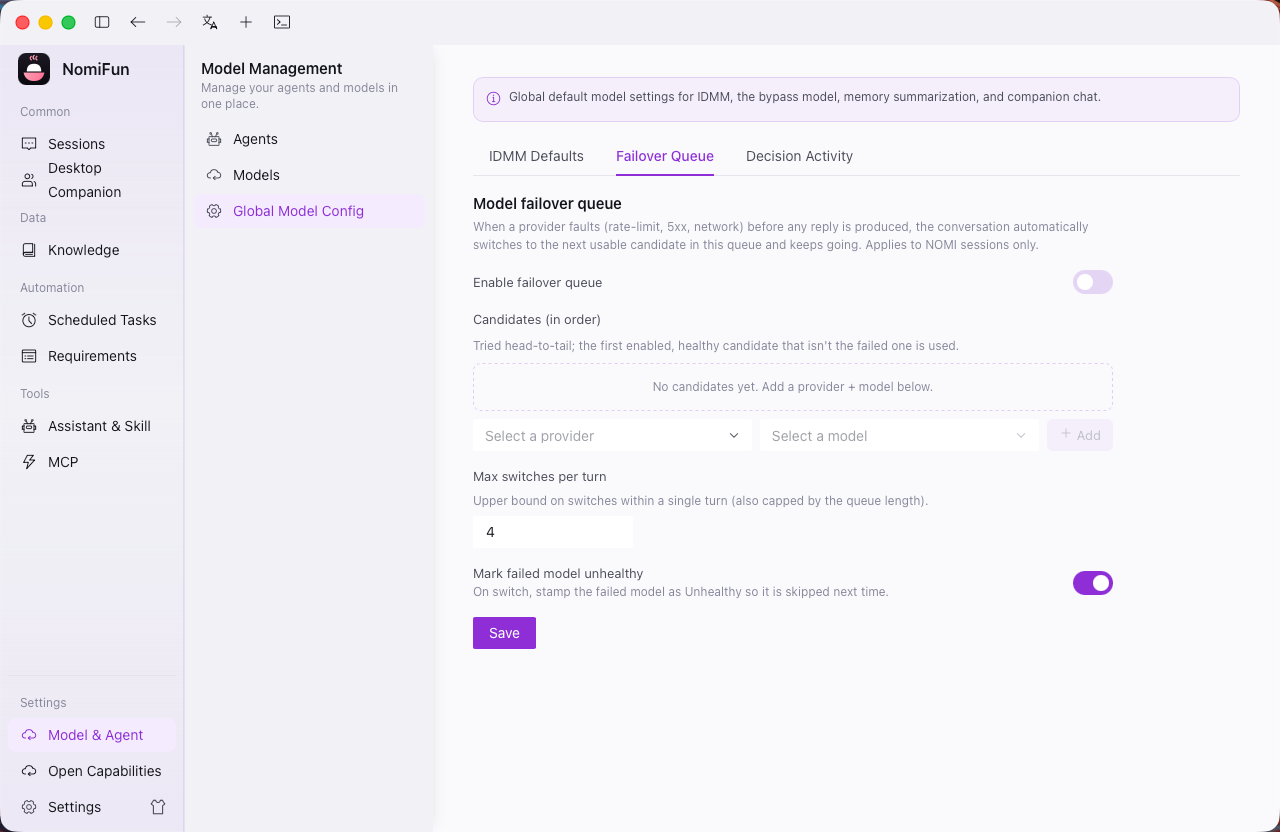
A common ordering:
primary → cheap backup → stronger backup → human check -
(Optional) Per-session override. The global queue is the default; an individual session can override it to use a different backup order for a specific task.
Notes & boundaries
- Nomi engine sessions only. This is an in-engine retry strategy. It does not spread load across multiple API keys, and it does not make all CLI / ACP agents share one model pool.
- Reliability, not quota. If every provider in the queue is down, or the turn’s prompt / tool state is itself invalid, failover can’t rescue that turn.
- Works with IDMM. When IDMM’s failure-watch judges a provider failure recoverable and the session has failover enabled, it lets the session retry along this queue. Failure-watch and decision-watch are off by default. See Unattended automation · AutoWork.
The ~19 external ecosystem agents
Beyond the native providers, NomiFun also connects to about 19 external ecosystem agents (e.g. Claude Code, Codex, OpenCode, Nanobot, OpenClaw) over ACP (Agent Client Protocol) or adjacent local agent runtimes. They run as separate runtimes in a terminal and you install and configure each one; the built-in nomi agent is a bundled CLI binary that needs no extra install.
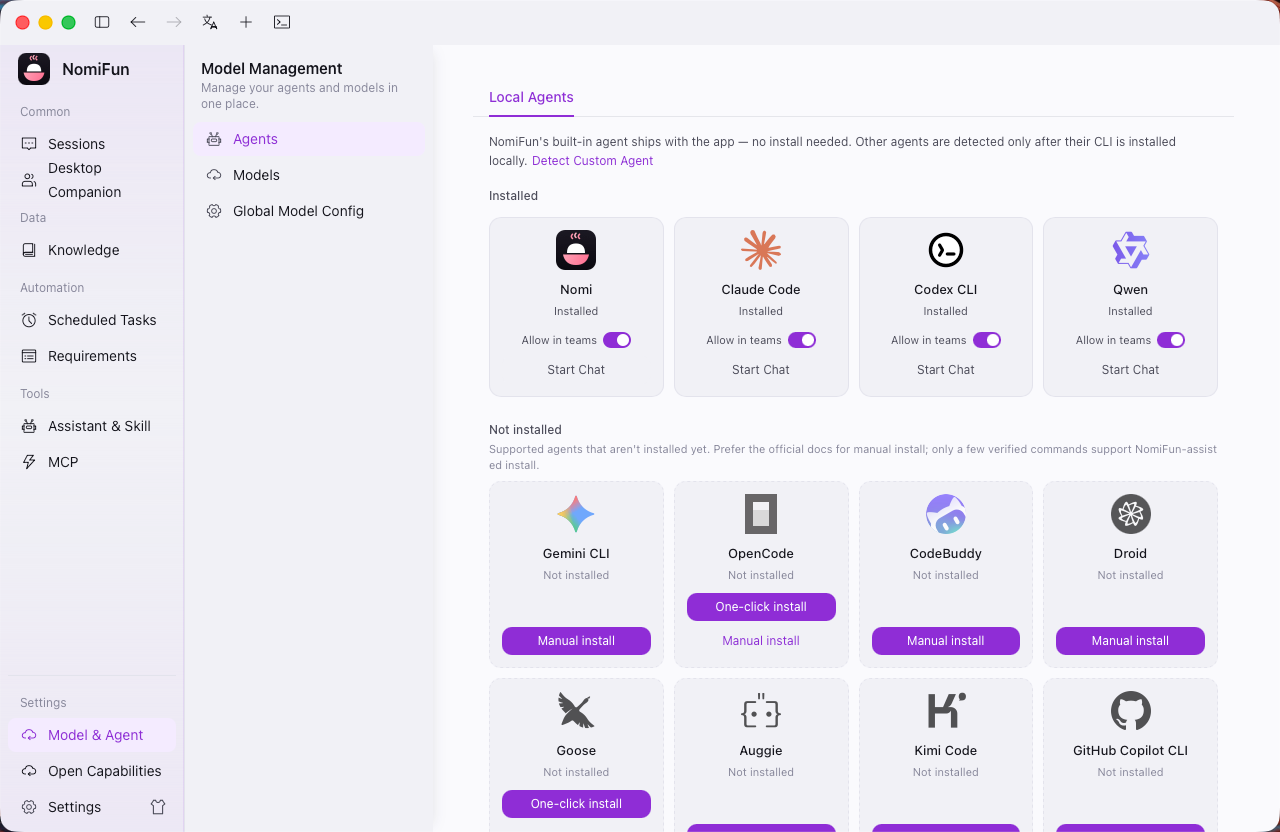
ACP / CLI agents do not participate in the failover queue above — their provider calls happen inside their own external runtime.
Related
Full docs → GitHub